
By Emmanuel Buah
Category: Lifestyle & Society
Date: October 27, 2026
The Debate Is Bigger Than Screen Time
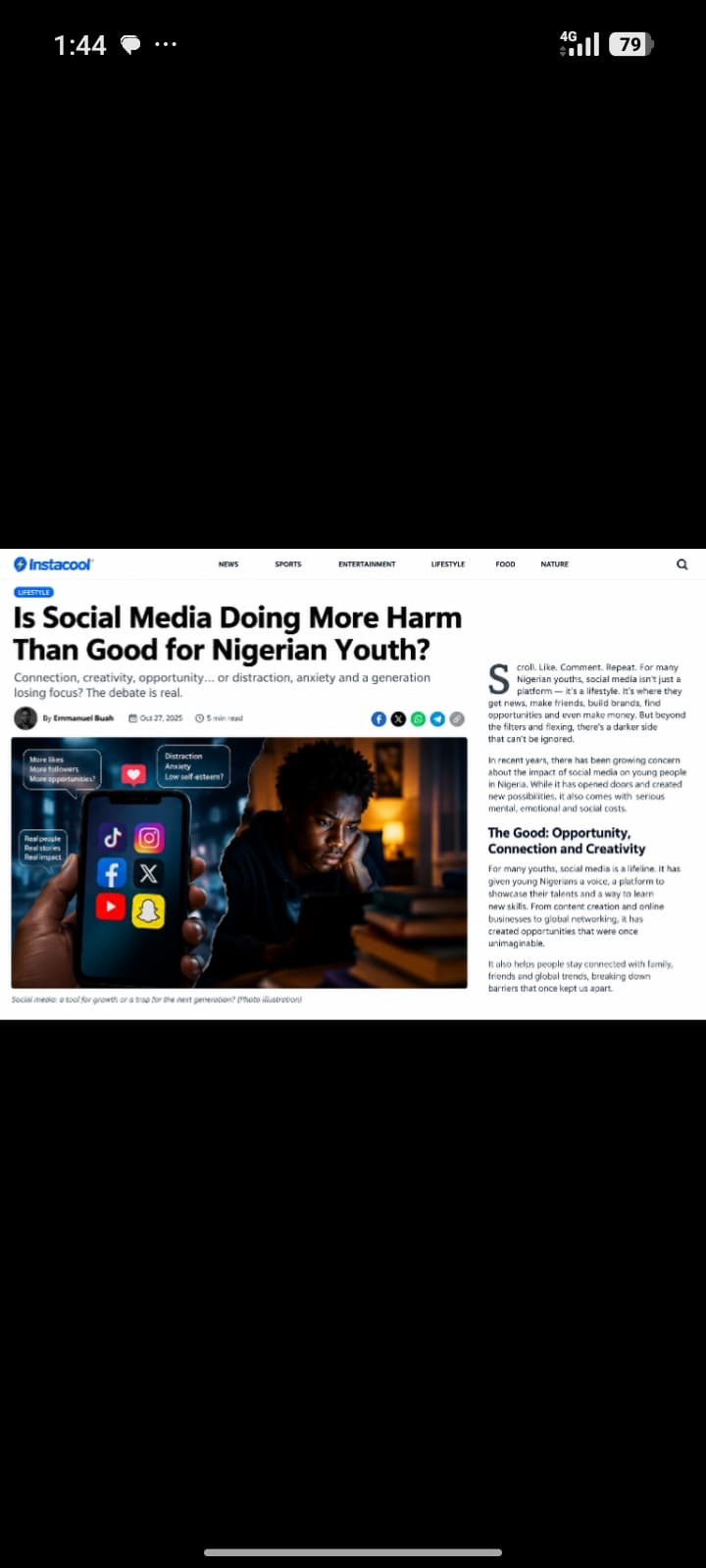
Social media has become one of the most powerful forces shaping how young Nigerians communicate, make money, consume information and measure success. From TikTok trends to Instagram lifestyles and debates on X, the digital world has become an everyday part of growing up.
But behind the viral videos, glamorous pictures and motivational quotes lies an uncomfortable question: Is social media helping Nigerian youths build better lives, or encouraging them to live for the approval of strangers?
The answer is not straightforward. Social media has opened doors that previous generations could only imagine, but it has also introduced pressures that deserve serious attention.
The Good: Opportunity, Creativity and Connection
For many young Nigerians, social media is more than entertainment. It is a marketplace, a classroom and a platform for self-expression.
A fashion designer can find customers without renting a shop. A musician can promote a song without securing a traditional record deal. A teacher can reach thousands of learners through educational videos, while a small business owner can advertise products to customers across the country.
Social media also allows young people to discover opportunities, exchange ideas, build communities and draw attention to important social issues.
For a generation facing unemployment, high living costs and limited access to traditional opportunities, these benefits are significant.
The problem, therefore, is not simply that young people use social media. It is what happens when using it becomes more important than what they intend to achieve through it.
The Bad: Comparison, Anxiety and the Pressure to Appear Successful
Consider a young graduate struggling to find employment. Every morning, their timeline is filled with people announcing new jobs, buying cars, travelling abroad and celebrating financial breakthroughs.
Some of those achievements are genuine. Others may be exaggerated, staged or presented without the struggles behind them.
Yet the comparison can feel real.
A person may begin to interpret another person's carefully selected highlights as proof of their own failure. Over time, this can contribute to frustration, insecurity and unrealistic expectations about how quickly success should happen.
The pressure is particularly intense in a culture where appearance, financial status and public recognition can influence social perception.
When success becomes something you must constantly prove online, even genuine progress can start to feel inadequate.
This does not mean every young person who uses social media will experience mental health difficulties. However, excessive use, cyberbullying, unhealthy comparisons and disrupted sleep can become serious concerns.
The Ugly Side: When Attention Becomes the Goal
There is another dimension to the controversy: the pursuit of visibility at almost any cost.
Online attention can reward outrageous behaviour, public humiliation, fabricated drama and dangerous challenges. Some users feel compelled to reveal private details, manufacture controversy or compromise their values simply to remain relevant.
The result is a digital environment where being noticed can sometimes matter more than being responsible.
Young people may also encounter online scams, misleading financial advice, fake giveaways and unrealistic promises of instant wealth. The desire to reproduce the lifestyles they see online can make them vulnerable to manipulation.
And when every achievement must be announced, every disagreement becomes content and every private moment becomes potential entertainment, the boundary between living a life and performing one becomes increasingly blurred.
Are Parents and Society Partly Responsible?
Blaming young people alone would be too easy.
Parents, schools, technology companies, advertisers and society all have roles to play in shaping healthier digital habits.
Parents need to encourage conversations about online safety rather than relying entirely on restrictions. Schools can teach digital literacy, including how to identify misinformation, recognise manipulation and protect personal information.
Technology companies should also be held accountable for how their platforms handle harmful content, harassment and features that may encourage compulsive use.
Most importantly, society must question the standards it promotes. If young people are constantly told that wealth, beauty, fame and expensive possessions determine personal worth, social media will simply amplify those expectations.
Should Nigerian Youths Abandon Social Media?
No. Abandoning social media entirely would mean giving up valuable opportunities for education, business, creativity and public participation.
The better question is whether young people can learn to use these platforms without allowing them to control their time, self-esteem and decisions.
Practical steps include setting limits on unnecessary scrolling, protecting sleep time, unfollowing accounts that encourage unhealthy comparisons, verifying information before sharing it and making room for offline relationships and activities.
Social media should be a tool that supports personal growth, not a scoreboard for measuring human worth.
The Final Question
Social media is neither entirely good nor entirely bad. Its effects depend partly on how it is designed, how it is used and what society rewards.
But one concern remains: a generation can be digitally connected while becoming emotionally exhausted, constantly informed while struggling to concentrate, and publicly celebrated while privately feeling inadequate.
The real danger is not that Nigerian youths spend time online. It is that some may begin to believe their lives only matter when other people can see them.
What do you think? Is social media creating opportunities for Nigerian youths, or is the pressure to stay relevant doing more harm than good?
Join the conversation in the comments.




0 Comments